

Buying a home is rarely just a cold financial transaction; it is an emotional milestone that anchors a family’s future. When families decide to buy home in Ludhiana, the decision-making process goes far beyond property size or price per square foot. Instead, it focuses on creating a safe, nurturing environment where children can grow, learn, and thrive.
Interestingly, children today act as vital stakeholders in the home-buying journey. From influencing neighborhood selection based on parks and playgrounds to shaping decisions around school commutes and home layouts, kids naturally guide parents toward better lifestyle choices.
This guide breaks down exactly how children impact the modern real estate journey and what parents should consider when planning to buy home in Ludhiana that supports their family’s long-term happiness and future.
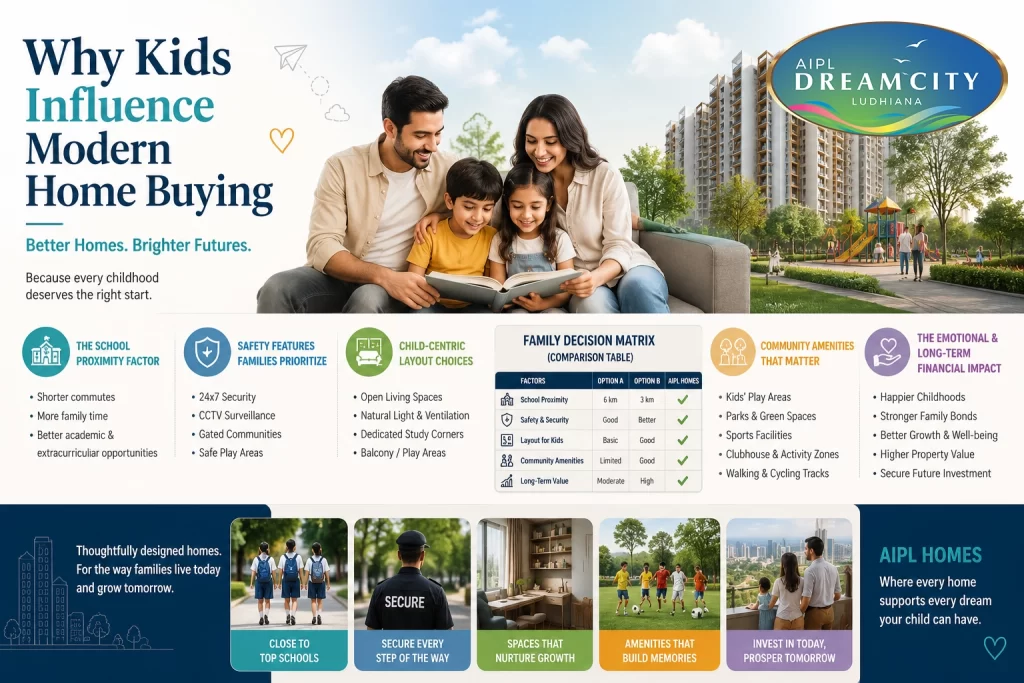
Table of Contents
- Why Kids Influence Modern Home Buying
- The School Proximity Factor
- Safety Features Families Prioritize
- Child-Centric Layout Choices
- Family Decision Matrix (Comparison Table)
- Community Amenities That Matter
- The Emotional & Long-Term Financial Impact
- Conclusion
- FAQs
Why Kids Influence Modern Home Buying
Parents no longer view their children merely as dependents who will occupy a spare room; they view them as active lifestyle partners. A child’s daily routine—ranging from play to sleep and study—dictates how a home needs to function.
Modern families actively reject spaces that feel restrictive, choosing instead properties that offer psychological and physical room for a child to grow.
The School Proximity Factor: Education as a Top Priority
Reputed educational institutions act as major anchors for residential real estate value. In cities like Ludhiana, neighborhoods situated near top-tier schools command a premium for a few distinct reasons:
- Reduced Commute Fatigue: Shorter travel times mean children spend less time stuck in traffic and more time on rest, hobbies, or studies.
- Extracurricular Availability: Proximity to school makes it easier for kids to participate in after-school sports, arts, and remedial programs.
- Sustained Property Resale Value: Homes located within prominent school districts hold their market value incredibly well, shielding parents from market downturns.
Safety Features Families Prioritize
Once children enter the equation, a neighborhood’s risk profile becomes a dealbreaker. Parents meticulously scan the surrounding environment before signing a deed, looking for specific security infrastructure:
The Checklist for Family Safety:
- Gated communities with active, 24/7 security personnel and perimeter CCTV surveillance.
- Dedicated pedestrian walking paths completely separated from vehicular traffic.
- Soft-surface or rubberized flooring in playgrounds to minimize injuries during play.
- Low traffic volume and well-lit internal streets.
Child-Centric Layout Choices
When evaluating a house layout, functionality wins over pure aesthetics. Parents look past trends like minimalist glass features to find practical elements that keep up with growing kids:
- The Multi-Purpose Study Room: With hybrid learning and digital education on the rise, a quiet, distraction-free zone is essential.
- Open-Concept Living Areas: A seamless flow between the kitchen and the living room allows parents to supervise younger children while handling daily chores.
- Adaptable Spaces: Extra bedrooms that can transition smoothly from a nursery into a teenager’s private study block over a decade.
Family Decision Matrix: Balancing Budget and Kids’ Needs
To visualize how a child’s age completely alters what parents prioritize in a home, review the comparative matrix below.
| Child’s Life Stage | Primary Location Driver | Critical Home Layout Feature | Must-Have Neighborhood Amenity |
| Toddler / Preschool (Ages 0–5) | Proximity to daycare & healthcare | Open-plan living for easy visual supervision; childproof balconies | Fenced parks, soft-surface playgrounds, toddler pools |
| Primary / Middle School (Ages 6–13) | Short commutes to top-rated schools | Separate bedrooms; dedicated homework/study nooks | Sports courts, safe bicycle lanes, hobby centers |
| High School / Teenager (Ages 14+) | Accessibility to coaching institutes & colleges | Enhanced privacy (extra bathrooms); high-speed tech zones | Public transit access, libraries, community centers |
Community Amenities That Matter
A kid-friendly neighborhood provides a built-in social fabric. Raising children in isolation is incredibly tough, which is why integrated townships and modern residential projects are so popular.
Environments that feature swimming pools, cricket nets, skating rinks, and indoor gaming rooms encourage children to step away from digital screens. Furthermore, these shared spaces help kids develop vital social skills, build lifelong friendships, and foster a healthy sense of community.
The Emotional & Long-Term Financial Impact
The Vital “Joy Factor”
Children form instant emotional attachments to spaces. A sunlit balcony, a small patch of green garden, or a room that fits a custom bunk bed can spark immediate excitement. Real estate experts note that if a child feels happy and comfortable during a property walkthrough, parents gain a massive wave of confidence to close the deal.
Strategic Budget Adjustments
Most parents are highly willing to stretch their home-buying budget if a property offers distinct advantages for their kids. Upgrading to a premium neighborhood with better safety, elite schools, and active sports amenities is viewed as a direct, non-negotiable investment in a child’s future wellbeing rather than an unnecessary real estate expense.
Conclusion
Children hold massive, undeniable influence over the modern real estate market. From dictating geographic coordinates based on top schools to modifying interior layouts for study and play, their needs sit right at the center of the household journey.
If you’re planning to buy house in Ludhiana, keeping your children’s current and future needs at the heart of your decision ensures a safe, fulfilling, and truly future-proof investment. After all, a home is far more than concrete walls and structural pillars—it is the foundational ecosystem where your children will learn, grow, and create lifelong memories.